SEO for Coworking Spaces in 2026: How to Surface on Google and AI Search
Rick Castle-Ward
Founder, CoworkGrowth
SEO for coworking spaces in 2026 covers two areas. The first is traditional SEO: keyword research, a crawlable website, optimised location pages, a complete Google Business Profile, consistent NAP across the web, quality backlinks, and a steady review profile. These fundamentals drive the majority of organic discovery and remain the foundation. The second is AI search visibility. ChatGPT, Perplexity, and Google AI Overviews now sit alongside traditional results and require a different approach: content structured for AI extraction, strong entity signals, and a brand presence that extends beyond your own website. Operators who cover both surface across the full range of channels high-intent prospects use to find a coworking space.
Why coworking space marketing matters more than ever in 2026
From the outside, the coworking industry appears turbulent. WeWork's bankruptcy filing in 2023, alongside a renewed corporate push toward office-based work, has fuelled the perception that demand for flexible workspaces is weakening.
Inside the industry, the picture is far brighter. Deskmag surveys show that the share of coworking spaces operating profitably has increased markedly in recent years, rising from around 40% historically to 54% by 2025.
WeWork's collapse was not driven by a lack of demand for desks. It was the result of an aggressive, debt-fuelled expansion strategy that exposed a fragile cost structure, not a representation of wider coworking fragility. Improving profitability among smaller independent spaces suggests that coworking remains a solid opportunity for operators who manage the fundamentals well, a view reinforced by projections that the sector will grow at roughly 14-15% per year through to 2030 (Grand View Research).
The fundamentals do, of course, matter. Community, location, atmosphere, layout, and service quality all play the main role in whether a space retains members and generates referrals. However, coworking spaces are not a highly differentiated service. At the point of discovery, many coworking spaces offer a somewhat similar service.
This is why marketing has become decisive. Once the core offering is strong, differentiation only works if it is visible. Operators cannot rely on having a Bauhaus interior or the largest reception area and expect demand to follow. Exceptional interiors, prime locations, or strong communities only create an advantage for growth if they are surfaced through search, reviews, and content. A coworking space can be the Ferrari of workspaces, but if no one knows it exists, it will lose demand to the Fiat Panda of coworking that simply shows up everywhere.
To capture demand consistently, coworking spaces can use both outbound and inbound funnels. This article does not focus on optimising internal operations or outbound sales efforts. Instead, it focuses on the more foundational system that underpins them both, the inbound funnel. In particular, it examines the most significant shift within it in recent years, SEO and AI-driven search, and why it has become the most effective response to the problem over 90 percent of struggling coworking spaces identified in the Deskmag 2023 survey: member acquisition.
How people find coworking spaces in 2026
Many marketers argue that business discovery has fundamentally changed over the past few years and that companies must completely rethink how they market to stay ahead. Ironically, this narrative is not new. Variations of urgency-based marketing have existed since the days of David Ogilvy.
While it is true that a good marketer should always look for the next edge, the reality is more grounded. The fundamentals of discovery have not changed as much as some would like to believe. The core principle remains the same: the more useful, visible content a business puts into the world, the more high-intent demand it captures in return. What has changed is where that discovery happens, as new platforms and interfaces emerge.
The most effective approach today is breadth. Coworking spaces perform best when they are visible across as many low-barrier discovery channels as possible. In practice, this includes Google Search, Google Maps, social media, referrals, directories, and increasingly, AI-driven search. Many of these channels are interconnected, meaning tactics rarely need to be replaced entirely, they usually just need to be adapted.
Recent data supports this multi-channel view. BrightLocal's 2025 Consumer Search Behaviour study shows that Google Search and Maps still dominate local business discovery. However, 14 percent of consumers now begin local searches on social media, rising to 26 percent among Gen Z. The same study found that 40 percent of consumers actively use generative AI features during their search journeys. This suggests that some share of traditional Google search behaviour has dispersed into social and AI-led discovery, even though Google remains the primary gateway.
In practical terms, this means coworking spaces should ensure they are visible across search, social, and emerging AI platforms. This is achievable when approached consistently, one-off efforts rarely compound. As with most aspects of running a business, sustained visibility comes from regular, focused execution rather than occasional bursts of activity.
This is where SEO and AI-focused optimisation converge. In practice, work done to improve structured, high-quality SEO assets increasingly supports AI visibility also. A pre-emptive approach to AI-oriented SEO in 2026 is likely to pay dividends. A Semrush study suggests that digital marketing could drive more visitors from AI search than traditional search by 2028, with early evidence indicating that AI-driven visitors are 4.4x more valuable in terms of conversion rates.
AI-driven visitors are 4.4x more valuable in terms of conversion rates than traditional search visitors.
Google Search itself remains central to an SEO strategy. For most businesses, it has been the primary traffic source for over a decade. The introduction of Google AI Overviews represents the most significant shift in the search experience during that time. A 2025 LocalFalcon study found that AI Overviews appear in 40.2 percent of local business searches, rising to 65 percent in certain service categories. While there is not yet a study focused specifically on coworking, early evidence suggests strong overlap with traditional organic results. Research from Geneo indicates that 54 percent of AI Overview citations reference pages that also rank on page one of organic search for the same query.
For coworking operators, the impact is straightforward. Discovery has a new layer. By focusing on strong fundamentals in content, local visibility, SEO and LLM SEO, it is increasingly possible to capture multiple discovery sources at once.
SEO and AI search as the core growth channels for coworking spaces
With the established reality that Google Search remains the primary way high-intent customers discover coworking spaces, and AI-driven search capturing an increasing share of this behaviour each year, attention to the inbound funnel has become paramount. Prospects searching Google or ChatGPT for "coworking spaces in [your area]" are already close to a purchase decision. At that point, the marketer's job is simple: make sure your space appears in front of them.
Research from OfficeRnD consistently points to the same conclusion. If coworking operators are forced to prioritise a single marketing channel, SEO, increasingly supported by AI-oriented optimisation, delivers the highest return. The primary reason is intent. Search captures people actively looking for workspace, not passively browsing.
Social media operates very differently. Users who encounter a coworking space on social platforms are often not searching for a workspace at all and may not even be in the right location. Their intent is lower by default. This does not mean social media cannot work. Organic social growth can be effective for building credibility and social proof, but it performs best as a supplementary channel layered on top of strong SEO foundations, not as the primary acquisition engine.
Referrals fall into a similar category. They are a powerful inbound source with high conversion rates, often converting over 30% better than other channels according to SaaSquatch, but they depend on an existing member base. Referrals tend to amplify demand once visibility already exists rather than creating it from scratch, making them most effective once a core SEO strategy is in place.
Paid channels introduce a different set of trade-offs. Paid social advertising, whether through influencers or ads, can generate leads but often at a higher cost per acquisition. Much of the spend reaches low-intent users who are not actively looking for coworking space or are outside the catchment area. You pay for those impressions regardless. The net is cast wide, and most prospects slip through.
Paid search offers a more targeted option, but still carries limitations. While paying to appear at the top of Google for high-intent queries can drive traffic, trust in sponsored results remains significantly lower than in organic listings. A 2025 study by Growth Factory found that the first organic search result achieved click-through rates of roughly 28%, compared to 2% for paid search ads. Many users still perceive sponsored results as less relevant, even when they are well targeted, before even considering the ongoing cost of maintaining those positions.
The first organic search result earns 28% click-through, compared to just 2% for paid search ads.
None of this is to suggest that paid channels should be avoided entirely. They can and do generate revenue. However, they perform best when layered on top of a lower-cost, higher-intent SEO foundation rather than used in isolation.
This is where the compounding nature of SEO is important. Unlike paid channels, SEO does not stop working when spend is paused. A well-optimised website and Google Business Profile continue to attract demand as authority builds. Over time, brand searches increase, backlinks accumulate, reviews stack, and visibility improves across both traditional search and AI-driven results. Rankings may decay gradually without continued effort, but they do not collapse to zero.
In practice, this creates a snowball effect. Each improvement makes the next easier. Visibility builds, trust compounds, and marginal costs fall. For capacity-constrained, locally driven businesses like coworking spaces, this makes SEO and AI-driven search the core long-term growth marketing method.
What LLM SEO is and why it matters for coworking spaces in 2026
As a relatively new part of digital marketing, LLM SEO has picked up a number of different names, with no single term consistently used across the web. The umbrella terms most commonly seen are LLM SEO (large language model search engine optimisation) and AI SEO (artificial intelligence search engine optimisation). Both broadly refer to optimising a business or its content to appear prominently in AI search results such as ChatGPT, Perplexity, and Google AI Overviews.
More recently, marketers have introduced additional sub-terms. The two most common are AEO (answer engine optimisation) and GEO (generative engine optimisation). AEO is typically described as optimising content to appear in AI-generated answers, particularly within zero-click search results where users query Google and receive an answer directly from an AI snippet such as Google AI Overviews without clicking a traditional result. GEO is described as optimising content or businesses to be referenced within large in-house AI models such as ChatGPT, Perplexity, Gemini, or Claude which operate in a more conversational manner.
Whether these distinctions genuinely require separate labels, or whether this is simply a classic case of overcomplicating marketing terminology, is for each to decide. In practice, the methodology behind appearing across these areas of AI-driven search is largely the same. There are small differences in blog and content formatting required to hit both, but the core pillar remains unchanged. Strong traditional SEO fundamentals are still paramount.
What has changed is user behaviour. A 2026 Search Engine Land study reports that users increasingly turn to AI search because it is faster, clearer, and less cluttered than traditional results. For businesses trying to capture high-intent demand, this shift matters. If users are asking AI systems about local coworking, those systems need to understand and trust your webpage to confidently surface your space.
For coworking spaces, this does not require a complete rethink of strategy. A space with a solid overall SEO foundation will often still appear in AI search results by default. However, without specific consideration for how AI systems interpret and reference information, that visibility can be inconsistent. The opportunity lies in improving how confidently a coworking space is represented, by layering LLM-specific considerations on top of an already healthy SEO strategy. This is particularly important for coworking spaces given their semi-homogeneous service offering and the intensity of local competition.
SEO and AI SEO foundations for coworking spaces in 2026
When digging into SEO foundations it is important to understand the mechanics behind it. Google continuously crawls and indexes billions of pages to store in a database called the Google Index. These pages are analysed and processed so Google can understand what each page contains and when it should be surfaced.
When Joe Bloggs searches for "coworking spaces near me" the pre-indexed results are pulled from the database and provided to Joe based on the perceived relevance, quality, and context, including local signals. These are the attributes SEO aims to improve.
AI-driven search engines such as ChatGPT and Perplexity follow a similar process, but with important differences in how results are selected. Rather than crawling the live web continuously, they draw from a combination of their own knowledge databases, third-party indexes, and very limited live retrieval. Their output differs in that they select sources to produce a single, coherent answer rather than ranking multiple options like Google Search.
These systems aim to minimise uncertainty and reduce errors, which leads them to favour a small number of sources with the highest perceived reliability. This is where the difference in SEO strategy emerges. This is, however, distinct from features such as Google AI Overviews, which sit directly on top of Google's existing index and primarily pull from pages Google already understands well, often favouring clear, concise, and structured content.
The rest of this article focuses on the practical work. SEO remains the foundation so we will start there. Traditional SEO breaks down into On-Page SEO, Off-Page SEO, and Technical SEO.
Local SEO
When Joe Bloggs moves to an area and wants to find a coworking space, the initial almost knee-jerk reaction is to pull out his phone and search 'Coworking spaces near me.' From here he sees the Google map pack (the Google Maps pop-up with coworking spaces nearby listed underneath) and the blue links of coworking blogs and websites that clearly have good SEO practices. If your space doesn't appear here you are practically invisible to the largest cohort of high intent cowork enthusiasts and leaving significant revenue on the table. Your visibility and credibility are both non-existent. Fortunately, following a logical sequence can help you rank higher in local searches.
Google Business Profile (GBP)
Your GBP is required to appear in the map pack and also helps build your reputation and confidence for Google to reference you in search. Fill it out as thoroughly as possible with numerous professional photos and information about your workspace. A video is also a great addition for the user experience, which is in turn rewarded by Google in rankings. Regularly post updates, offers and events to your GBP, which will appear in maps and search and signal to Google that your business is active. One note here: your general information such as trading name, address and phone number (NAP) needs to be consistent across all other online sources including your website footer, Yelp and social media. Inconsistencies will damage your trustworthiness with Google.
You should also set up a Bing Places for Business to capture searches through Microsoft software, which is often overlooked and therefore easier to rank near the top. This is also essential as AI search engines like ChatGPT and Perplexity often use real-time search from Bing rather than Google. Follow the same protocols as your Google Business Profile and make sure your sitemap is indexed on Bing Webmaster Tools and Google Search Console.
Reviews
The other aspect of a GBP is its Reviews section. Google continues in 2026 to be the most used reviews platform, massively outperforming platforms like Trustpilot and Yelp, with BrightLocal finding that 83% of consumers use Google reviews for decision making for service businesses. Reply to all reviews, both positive and negative, to boost your perceived trust and show prospective members that you are an attentive operator. Sign up to Yelp and Trustpilot as well, both of which directly influence your SEO due to their high traffic and domain authority. Consistent reviews across all three platforms are a great signal to Google and AI search that you are an active business and act as mini SEO posts themselves for searches such as 'Top rated Coworking Space near me.'
Encouraging a steady flow of reviews does not need to be complicated. Email members occasionally asking for honest feedback, or place QR codes around the office with incentives such as entering everyone who leaves a review that month into a draw for a free month of membership or a guest day pass for a friend. You could even tie it in with referral marketing; refer a friend and leave a review for £100 off your next month's membership. Timing a review push after a positive interaction such as an event tends to get the best response rates.
Local keywords
One crossover between Local and On-Page SEO is including local keywords in your content and website. The goal is to become a trusted source for Google and in turn AI search for terms such as "coworking space in [area]" and "startup office space [city]". Use these local keywords in key places across your website and any articles you write, such as title tags, H1s and H2s, meta descriptions and your GBP. For example, if you are a coworking space operating in Canary Wharf a H2 on your website might read "Find Your Ideal Coworking Space in Canary Wharf for Startups and Remote Teams". A good FAQ question would be "How much does coworking space in Canary Wharf cost compared to a traditional office lease?". The key is to mention relevant keywords naturally without overloading your website, as too many can negatively affect your trustworthiness with Google.
A useful tip for local SEO is to apply schema markup formatting to your FAQ section. This is essentially HTML code that tells Google a piece of content is a question and answer, which means your response can be cited directly in search results as an expandable dropdown or pulled into an AI overview. It is one of the faster wins available for local visibility and requires no changes to your visible content. A deeper schema markup guide is in the Technical SEO section of this article.
One important part of Local SEO is writing blogs and articles on your website. Successful blogs drive clicks from high intent users, earn backlinks from websites referencing your articles, and get listed by Google as snippets on the SERP. They are a key source of SEO gravity and we will touch on content strategy in more depth in the On-Page SEO section.
Local keywords are key to local SEO success as they typically have lower volume than broader searches but significantly higher conversion rates, with Marketing LTB claiming up to 30% higher than general search terms, and 76% of "near me" searchers visiting a location within a day. You may now be thinking what local keywords should I be targeting. There are a few tools worth knowing about for researching what keywords your high intent, cowork-hungry prospects are actually searching.
76% of "near me" searchers visit a location within a day.
Google Keyword Planner sits inside Google Ads and lets you see keyword volume and ideas by city or radius. Google Trends shows query interest over time at a local level. Local Falcon is built specifically for local SEO and gives you keyword ideas by city or postcode. If you want the most comprehensive paid option, Ahrefs is the swiss army knife of SEO research, with a keyword explorer that shows what your competitors are ranking for and estimates the traffic you would gain by closing the gap.
One key point at this stage: the keywords with the highest search volume are not always the ones that will drive the most conversions for your space. A search for 'Meeting rooms in [niche coworking location]' may show low volume on Ahrefs but convert at a significantly higher rate than a broad term. It is worth experimenting with the terms you genuinely believe your ideal members are searching for.
On-Page SEO
On-page SEO is optimising a webpage to attract relevant searches. Think of it like an article written as a single block of text with no paragraphs, no titles, no images, no H1s or H2s. Nobody would read it and nobody would share it, even if the writing standards were those of Ernest Hemingway. On-page SEO is the formatting that signals to Google and AI search what your content is about and why it deserves to be surfaced.
Title tags
For on-page SEO a good place to start is the title tag. Each page of your website should have its own title tag which is written in the HTML code of your website. It looks like this:
The title tag is the label for Search Engine Results Page (SERP) and the label for the browser tab. You should include a title tag on every indexable page that you want to rank on for example the homepage, location pages, space pages, pricing and blog articles.
If you are using a Website maker like Webflow you can set the title tag in the SEO settings. If you are getting your website custom made they should set all your title tags but it is good to double check. If you add any content or blogs it is very important you correctly set the title tag.
The title tag tells the user what your page is about and whether it is worth clicking. It is also used by Google to understand your page and determine whether it is applicable to a given search query. Keep it to a maximum of 55-60 characters so it fits cleanly in the results and does not get cut off. A good title tag contains the primary keyword you are trying to rank for and matches the intent of the searcher. Avoid forcing in multiple keywords as Google has directly said keyword stuffing can negatively affect your rankings. The standard structure is primary keyword, location, then intent. For example: Coworking Day Pass in [Location] | Book a Desk for the Day | Cowork Brand.
For article title tags there are simple techniques to boost click through rate. Including the year such as "…in 2026" signals fresh content, and leading with a specific number sets clear expectations for the reader, for example "10 best coworking spaces near [location]." Avoid choice overload though; too many options in a title can overwhelm and reduce clicks. A good rule of thumb is to keep any numbered list below 20.
Meta descriptions
Meta descriptions summarise the content of a webpage in two to three lines and normally appear under the blue link on the SERP.
They don't directly affect the SEO of the page but they do influence click through rate (CTR), which makes them worth getting right. Set a different meta description for each page, briefly summarising the content with a primary keyword without stuffing. Write it for human readers and close with a call-to-action such as "Check Availability", "View Prices" or "Book Now."
For AI search, the approach shifts slightly. Rather than descriptive marketing copy, AI systems extract factual signals, so pack your meta description with key information; prices, special amenities, location, opening hours and anything else that differentiates your space. Normal marketing jargon such as "Cosy coworking space in the heart of the City of London" will not cut it. It is information over description. "Premium Coworking Space | From £400p/m | 5 minutes from Euston Station | Open 24/7 | Book now" is a good example of an AI optimised meta description.
If you have built your website on Webflow or any of the other popular website builders you can change the meta description in the SEO settings.
Headers (H1, H2, H3)
Headers should be used across your webpages and content to add logical structure and readability. Each header is also an opportunity to touch on keywords you want to rank for, so it is worth thinking about this when structuring a page rather than as an afterthought. There should only be one H1 per page but numerous H2s and H3s to break up the content. Keep the keyword usage natural; shoehorning in too many can read as stuffing and Google will penalise you for it.
Articles and content
The blog section to the SEO practitioner is akin to old linen for the Shakespearean scribe. It can be the deciding factor in whether Google deems your webpage, to be or not to be, seen by high intent customers. Blogs let you target keywords your homepage can't touch, capture searchers who aren't quite ready to book a desk yet, and earn backlinks from local news sites, business directories and industry publications that would never link to a sales page.
When someone types a question into Google or ChatGPT such as "What's the coworking scene like in Shoreditch?" or "Is a hot desk worth it for freelancers?" they're not looking for your homepage. They want an answer. A well-written blog post gives them that answer, positions you as the local expert, and puts your brand in front of them before they've even decided where to work. AI Overviews in particular prefer well structured, bulleted answers that match search queries and will very rarely pull from a homepage, which makes blogs the primary vehicle for AI search visibility.
Research by HubSpot suggests that topic clusters, a pillar long-form article supported by shorter spin-off articles, receive 43% more organic traffic than articles that do not follow this structure. Most coworking spaces opt for the classic marketing blogs on sustainability and B corp accreditations, which are great for reaching that audience, but adding pillar articles that go deep into the coworking industry with novel findings and layering shorter spin-off articles around them will capture far more demand from coworking enthusiasts actively searching. You get indexed for more queries, and original ideas attract backlinks which compounds your authority over time. Aim for 4,000-5,000 words for your pillar article and 1,200-2,000 words for your spin-offs. The creme de la creme would be to survey your members on their coworking preferences or the industries they work in and publish the findings; original data is consistently rewarded with rankings and backlinks.
The generally accepted method for writing articles optimised for AI search in 2026 is to open with a short summary in the first paragraph that directly answers the question or summarises the topic, then go into far more detail in the remainder of the article.
The other form of article very well received by AI overviews and snippets are the rather humorously named listicles. These are articles built around bulleted lists such as '10 best coworking spaces near Liverpool Street' or '15 best 24/7 coworking spaces in London'. When writing listicles optimised for AI overviews it is best to reverse engineer the title. Think about what your high intent prospects in your area are likely searching and match the title to that query. The most obvious is "Best coworking spaces in [your area]" for which you would make the title "The 10 best coworking spaces in [area]: A 2026 guide". Most queries in this category start with "best" so be sure to optimise for that. By matching the listicle title directly to the query you have a much better chance of getting featured in AI snippets, capturing zero click search traffic and appearing above the blue links.
A quick note on volume: blogs are extremely useful for SEO but it is a case of quality over quantity. You don't want as many articles as humanly possible, but instead a managed set that gets consistent clicks and impressions, which you can monitor in Google Search Console. It is better to refresh and optimise old articles than constantly push out new ones that never get any attention. The goal is to be Michelangelo not Ikea.
Some quick fire tips for articles for AI Search and SEO:
- Recent content performs better in AI search. A 2025 study by Ahrefs showed that content cited by AI systems is 25% fresher than content ranking in Google's organic results meaning newer content is prioritised. This means it is important to refresh old content and add new, quality blogs to stay on top.
- Summarise the findings or answer the question in the first paragraph. Then go into more detail in the remainder of the article.
- New ideas, research and data perform best. Including primary research will improve your citations and earn you more backlinks which further compounds your citations.
- Have exceptionally clear formatting and structure, AI search responds best to logically structured articles.
- As AI search is relatively new the way AI engines index and pull information is constantly changing so constantly read the latest ideas and research on what is working. What is working right now is likely not going to be the same as what will get the best results in 2027.
- Do not get AI to write your articles, only structure and some research and direction. A 2025 study by WebFX found that AI content leads to an initial increase in traffic but then a near 100% organic traffic decline in some cases.
Using AI with blogs and articles
It is becoming increasingly common to see software promising AI optimised articles that will transform your inbound traffic, or YouTube videos on getting AI tools to manage all your website's SEO. AI can be very helpful for technical SEO and general optimisation tasks, but if you use it to write your blogs and articles end-to-end it will damage your reputation and lead to fewer citations. HubSpot suggests that AI content leads to traffic declines, weakened brand authority and potential policy violations. AI search engines do not want to exacerbate the dead internet theory and become an echo chamber of AI generated content. Novel ideas and original data are rewarded. AI written articles are penalised in the same way keyword stuffing is downgraded by Google.
Use AI to make your SEO work more efficient; research, planning and structuring are all fair game. The moment it is writing and publishing your articles, you will see negative SEO effects. Work in conjunction with AI tools and you will have no issue, reaping the benefits of the same technology you are optimising for. Don't fall for the AI shortcut marketing.
Off-Page SEO
Off-Page SEO covers everything that builds your authority outside of your own website, the main driver being backlinks; links to your content from other webpages. Backlinks point to your site as a trusted source that Google and AI have confidence in citing. The recurring theme applies here too: quality over quantity. 10 backlinks from high domain authority sources relevant to coworking will outperform 100 backlinks from low authority domains in irrelevant sectors. Domain authority is the metric developed by Moz to define how likely a domain is to rank on the SERP. High DA sources include Forbes, Business Insider and local news sites; low DA includes link farms and free article submission sites. On a scale of 1-100 you should aim to get links from relevant sources with a DA score of 30+. You can check a domain's rating using Ahrefs.
For sourcing backlinks, the first option is your existing community. Hosting events and meetups is a great way to build natural backlinks from attendees and event listing sites. Writing content that attracts backlinks through strong primary research and original data is the other reliable method; journalists and bloggers reference novel findings and each citation builds your authority further.
The next option is direct outreach, targeting the more authoritative sources you want to get referenced in. Below are the editorial sectors where you are most likely to find journalists covering topics relevant to coworking.
- Commercial property & real estate
- Future of work & remote work
- Startups & entrepreneurship
- Lifestyle & wellbeing
- Local business & city guides
- Architecture & interior design
- Travel & digital nomad
Search each publication for journalists who write about local businesses and reach out via LinkedIn or email. The aim is to build a relationship, not ask for a link. Offer yourself as an expert source they can quote when writing about flexible workspaces, remote work trends, or the local business scene.
HARO is also worth using regularly. The platform connects journalists with expert sources and responding to relevant queries is one of the more reliable ways to earn quality backlinks with relatively little effort.
A well known tactic in the SEO industry is to search for any existing mentions of your space in articles that do not currently link back to your page. Reaching out and asking for the link to be added is a quick win, though it is only viable once you have enough presence to be getting mentioned in the first place.
Directories are a great source of backlinks and some double as booking platforms, giving them the potential to drive direct leads as well. A few worth listing on:
Make sure your NAP and company details are consistent across all directory listings. Inconsistencies here undermine the same NAP consistency you are working to maintain everywhere else.
Technical SEO
Technical SEO is the structure of your website that underpins the broader SEO strategy. It is the plumbing that allows Google and AI to extract what you do, who you serve and what makes your space worth choosing, as quickly as possible and in a format that is easily digestible. If your technical structure is messy and cumbersome it will negatively impact your ability to get surfaced for relevant queries. For workspace operators with large websites covering multiple pages, offerings and local signals, getting your technical structure right is integral.
Schema markup
The first piece of the technical SEO puzzle is schema markup, which I touched on briefly in the Local SEO section. It is basically a TLDR for AI and Google crawlers to get a quick overview of your service. The importance of schema is debated among SEO experts but given it's relatively easy to add into your website backend it's best to add regardless, and a few types are definitely important.
LocalBusiness schema provides basic information such as name, address, phone, opening hours, price range and amenities. If you have multiple locations, each location page needs its own LocalBusiness schema with the correct information for that site.
FAQ schema allows crawlers to parse your FAQ content, which is useful for getting cited in AI overviews and expandable results in search.
Organization schema establishes the parent brand and allows Google to correctly link your company structure across all pages.
IsPartOf schema is verified as making a meaningful difference to SEO, linking different entities such as social media profiles, location pages and your parent brand together so Google understands how everything connects.
BreadcrumbList schema provides a hierarchy for your website structure, telling Google how each page sits within the wider site. This is particularly useful if you have numerous service and location pages across different areas.
It is integral that the information in the schema matches the visible content of the website. Discrepancies will confuse Google and damage your NAP consistency.
Implementation depends on your website platform. For WordPress, plugins like RankMath or Yoast handle most schema types automatically. Webflow allows you to paste schema directly into custom code embeds in the page settings. Squarespace is more limited and may require workarounds. If your site is built on Next.js or another custom framework, your developer can add JSON-LD scripts directly into the page head. JSON-LD is the format Google recommends and is the easiest to implement and maintain. Whichever route you take, validate every schema you add using Google's Rich Results Test or the Schema Markup Validator before assuming it is working correctly. If you want to go deeper, Google's structured data documentation is the most reliable reference point.
Internal linking
Internal linking is an important component of technical SEO. Much like BreadcrumbList schema it allows Google to understand which pages are most important, what is supporting content, and how commercial pages relate to informational content.
In practice, your homepage and commercial pages should link out to supporting content, each blog should link back to relevant commercial pages, and every location page should link to your other location pages so Google understands they are part of the same entity. This is a dynamic situation where new content is constantly being added, so check your internal linking regularly to make sure there are no links pointing to unindexed or outdated pages and that new content is being linked to from existing pages. Use descriptive anchor text rather than inserting bare links; hyperlinking 'Coworking in Shoreditch' to the relevant location page is a good example of this done well.
An orphan page is a page with no internal links pointing to it and is best avoided as Google will struggle to find and index it. You can audit your internal linking using Screaming Frog. Getting this right will noticeably speed up how quickly new pages get indexed and referenced in search.
Site speed and Core Web Vitals
If your website loads too slowly, particularly on mobile, it can negatively affect your rankings. It is not, however, the core ranking factor many SEO practitioners would have you believe. Check your page is not in the red for mobile speed on Google PageSpeed Insights and if it is, adjusting image formats and compressing files will resolve most issues. The SEO difference between an average loading time and a fast one is negligible. The more pressing issue for coworking spaces is conversions; image heavy sites that load slowly will lose visitors before they have even seen the space, which is reason enough to fix it regardless of the SEO impact.
What coworking spaces should track monthly
Tracking your SEO performance does not need to be complicated. The aim is to spot trends and catch issues early. The following metrics give you a clear picture of whether your inbound funnel is improving month on month and most can be checked in under thirty minutes using free tools.
- Google Search Console impressions and clicks. A healthy trend is both rising together. If impressions are climbing but clicks are flat, your title tags and meta descriptions need work.
- Top performing queries. Which search terms are driving traffic to your site. Look for new queries appearing month on month and unexpected wins you can lean into with more content.
- Average position for target keywords. Track your ranking position for the five to ten queries that matter most such as "coworking [your area]" and "day pass [your area]".
- Google Business Profile insights. Direction requests, calls, website clicks and profile views. These are high intent actions and a strong leading indicator of bookings.
- Reviews. Total review count and average rating across Google, Yelp and Trustpilot. Aim for steady growth in volume rather than chasing a perfect average.
- AI search visibility. Run your priority queries through ChatGPT, Perplexity and Google AI Overviews once a month and note whether your space appears, which competitors appear, and what context you are mentioned in.
- Competitor analysis. Pick three to five direct competitors in your area and track their rankings, GBP review velocity, new content output and any backlinks they have picked up that you have not. The aim is to understand what is working in your local market, not to copy them.
- Backlinks. New referring domains gained over the month using Ahrefs Webmaster Tools. Quality matters more than quantity.
- Organic traffic. Total visits from search engines using Google Analytics or your platform's built in analytics. Look at the trend over a rolling three to six month window rather than month to month.
- Conversion actions. Tour bookings, day pass purchases or contact form submissions originating from organic search. The metric that ultimately ties SEO work to revenue.
- Indexed pages and technical issues. A quick scan of Google Search Console's Coverage report to confirm new pages are being indexed and no errors have appeared.
- Top performing content. Which blog articles and pages are driving the most traffic and conversions. This tells you what to write more of and which older articles are worth refreshing.
How to test your AI search visibility
Running a quick visibility check against the priority queries your prospects are actually using is the fastest way to know where you stand. The approach we use is straightforward.
Pick eight queries across three categories: location-specific (e.g. "best coworking space in Shoreditch"), product or feature-specific (e.g. "coworking space with podcast booth in London"), and broad discovery (e.g. "best coworking space in London"). Run each query through ChatGPT, Perplexity and Google AI Overviews in an incognito browser while signed out, so personalisation does not skew the results. For each query, note whether you appear, where you sit in the list, and whether the information cited about your space is accurate. Track the same for the competitors that come up.
It is worth being honest about the limits here. AI search results are not deterministic. Run the same query twice and you can get different output, particularly on ChatGPT. A single test is a snapshot rather than a verdict. But run it across eight queries and three platforms and the pattern becomes clear. You will quickly see which categories you are absent from, which competitors are dominating which platforms, and where the easy wins are.
We run this for clients monthly. Doing it yourself once a quarter is enough to spot any major drift. If you want a faster starting point, our free AI Visibility Checker runs your space against a set of priority queries on ChatGPT and Perplexity and shows where you sit and which competitors appear ahead.
LLM SEO checklist for coworking spaces
AI search engines build their understanding of your brand from the wider web rather than from your homepage alone. The strongest coworking spaces in AI search tend to have a presence across multiple content types and platforms. YouTube tours of the space and member interviews. Podcast appearances on remote work or local business shows. Active monitoring of Reddit threads and Slack communities where coworking comes up, both to participate genuinely and to surface where your space is mentioned. Some examples include guest articles on industry publications, Quora and forum answers, local press coverage. Each of these contributes to the entity graph that AI systems reference when deciding whether to cite you. It is why LLM SEO is rarely a one channel job and why most operators benefit from working with someone who can coordinate this across channels rather than treating each in isolation.
The checklist below is a quick reference of the highest impact actions covered in this guide. Work through these in order and you will have the foundations of a strong LLM SEO presence within a few months.
- Get the SEO fundamentals right first. AI search rewards strong traditional SEO. Without solid foundations the rest of this list will not compound.
- Claim and fully optimise your Google Business Profile and Bing Places for Business. AI search engines often pull from Bing rather than Google, so both matter.
- Maintain NAP consistency across every online mention of your business. Website, GBP, Bing, directories, social profiles, backlinks. Inconsistencies actively damage trust.
- Add LocalBusiness, FAQ, Organization, IsPartOf and BreadcrumbList schema to your website. Validate everything with Google's Rich Results Test before assuming it is working.
- Build location pages that are genuinely unique to each location. Same template, different content. AI systems will not cite a page that looks templated and thin.
- Write a pillar article on your area or industry niche backed by spin off articles. Original research and primary data perform best. Aim for citations and backlinks, not word count.
- Open every article and key page with a direct summary of the answer in the first paragraph. AI systems pull from the top of the page first.
- Format content with clear headers, bullet points and structured FAQs. AI overviews almost never pull from a wall of text.
- Refresh existing articles regularly. AI cited content is on average 25% fresher than organic ranked content. Old articles that no longer rank are candidates for an update before they are candidates for deletion.
- Build backlinks from relevant high authority sources. Ten quality links beat a hundred low quality ones. Editorial mentions, journalist relationships and primary research are the durable methods.
- List your space on the major coworking directories. Coworker, LiquidSpace, Deskpass, Croissant and CoworkingCafe at minimum.
- Encourage consistent reviews across Google, Yelp and Trustpilot. Volume and recency both matter. Reply to every review.
- Diversify the content types your brand appears in. YouTube tours, podcast appearances, guest articles, forum answers and local press all feed the entity graph.
- Run your priority queries through ChatGPT, Perplexity and Google AI Overviews monthly. Track which competitors appear and what context you are mentioned in.
- Do not let AI write your articles end to end. Use it for research, structure and editing. Published AI content gets penalised in AI search the same way it does in Google.
- Make sure your website is server side rendered so AI crawlers can read it. Older single page React sites are often invisible to GPTBot and PerplexityBot.
- Treat LLM SEO as ongoing rather than a one-off project. AI search is moving quickly and what works in 2026 will not be exactly what works in 2027. Stay current and iterate.
A 90-day SEO action plan for coworking spaces
The work outlined in this guide is broad. Most operators do not have time to action all of it at once, and trying to will result in nothing being done well. The plan below sequences the work into a 90-day window, prioritising what actually moves bookings rather than what looks busy on a project board.
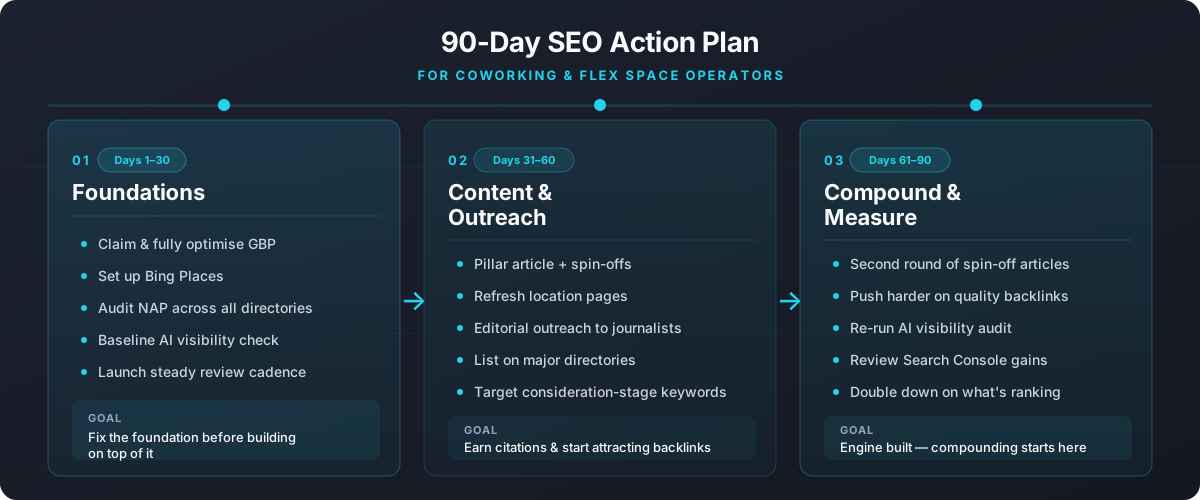
Days 1-30: foundations
Claim and fully optimise your Google Business Profile. Photos, full opening hours, services, FAQs, opening posts, the lot. Do the same on Bing Places. Audit your NAP across the web and fix any inconsistencies. Run a baseline AI visibility check against your priority queries on ChatGPT, Perplexity and Google AI Overviews so you know exactly where you currently stand. Get a steady review push live, whether that is QR codes around the space or an email cadence after positive interactions. Reviews compound and you want them stacking from day one.
Days 31-60: content and outreach
Start producing the content that actually earns citations. One pillar article, ideally backed by primary research or member survey data, supported by two or three spin-off pieces aimed at the queries your prospects are actually searching. Refresh any existing location pages so each one is genuinely unique to that site rather than a templated copy. Begin editorial outreach to journalists covering remote work, commercial property and local business, positioning yourself as a source they can quote rather than someone asking for a link. List the space across the major coworking directories.
Days 61-90: compound and measure
Continue the content cadence with a second round of spin-off articles. Push harder on backlinks now that you have research-led content worth referencing. Run the AI visibility audit again against the same queries you tested in month one and compare the delta. By this point Google has had time to crawl and index the changes, so check Search Console for what is gaining traction and lean into it. The first 90 days build the engine. Compounding visibility starts from here.
So there you have it, a foundational guide to taking control of the largest organic discovery channel available to coworking spaces. With consistency and targeted effort in the areas outlined in this guide, you will easily outperform competitors that produce a pretty website and a few blog posts on 'How Coworking Boosts Productivity' (I hope you now realise why this is not optimal content for SEO) and think their SEO job is done. Taking control of search is rewarded with steady enquiries and owning prime real estate across Google, AI search, and all the local searches that come with it.
If you would like to discuss anything covered in this article, book a complimentary AI visibility audit and we will run your priority queries through ChatGPT, Perplexity and Google AI Overviews, identify exactly where your space is being missed and what to do about it. CoworkGrowth partners exclusively with coworking spaces and have improved visibility and inbound enquiries for operators across continents.
Related Articles
Need help implementing this for your coworking space?
Get a free visibility audit and see how your space ranks in both traditional and AI search.
Book A Visibility Audit